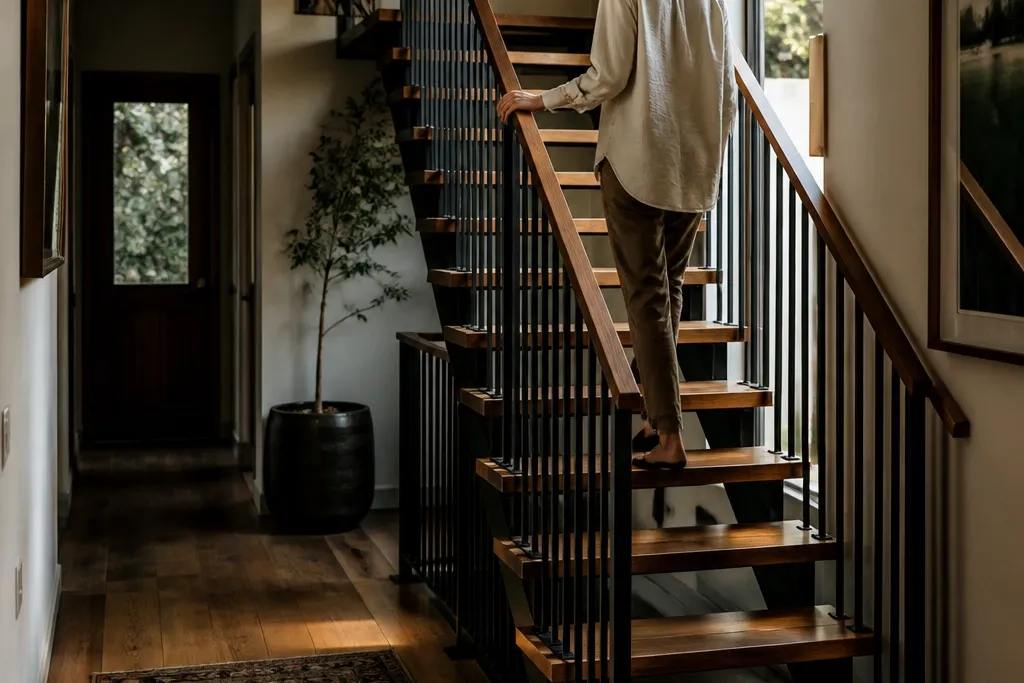
1. Matte black steel posts with walnut handrail and 4 spaced vertical slats
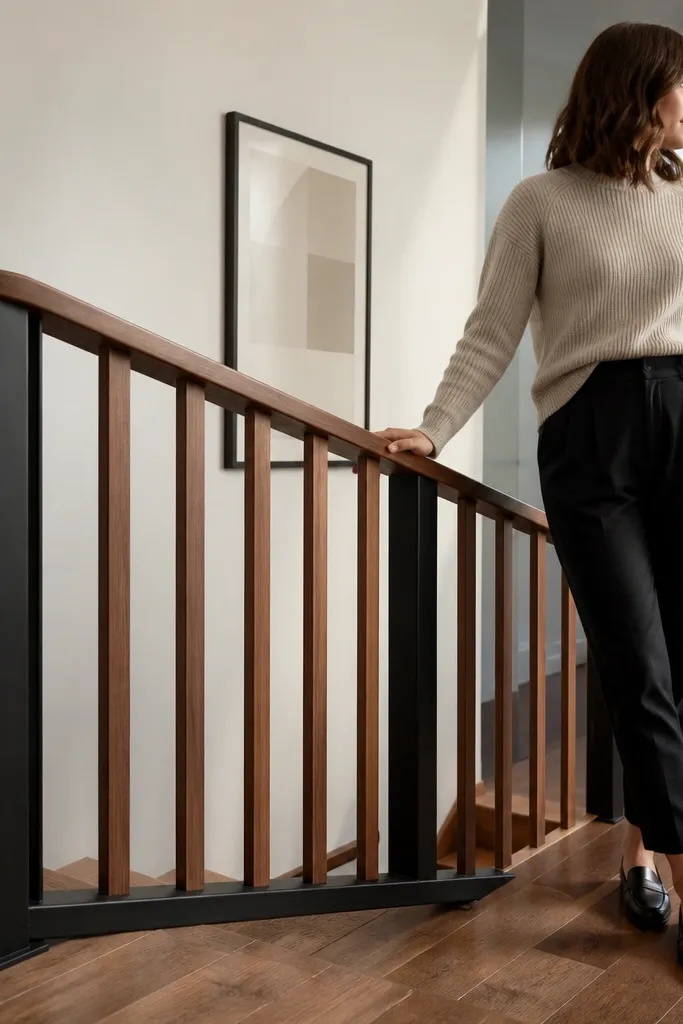
Measure your stair run and mark post locations so the slats land at consistent intervals. Install matte black steel posts first, plumb each one, and secure with the right anchors for your stair material. Then cut walnut handrail to length, add a 1/8 in. Roundover on the top edge, and attach it to the posts. Finally, install four vertical slats between the rails using hidden pocket screws from the underside of the handrail and a spacer jig to keep gaps equal.
This is the warmest version of “minimal” because the handrail does the heavy lifting. Walnut brings a brown tone that softens matte black steel, and the four vertical slats keep the visual rhythm simple. The spacing matters — you want repeating gaps that look even from the landing, not random. Use this when you have a wood floor or stained trim and you want the railing to match the house’s warmth instead of fighting it.
Skip thisDon’t use glossy metal paint — it makes matte wood look dull and cold.
Editor's noteMake a cardboard spacer strip for the slat gap so every repeat is identical without measuring each time.
2. Reclaimed pine top rail with black cable infill and one wood kick panel
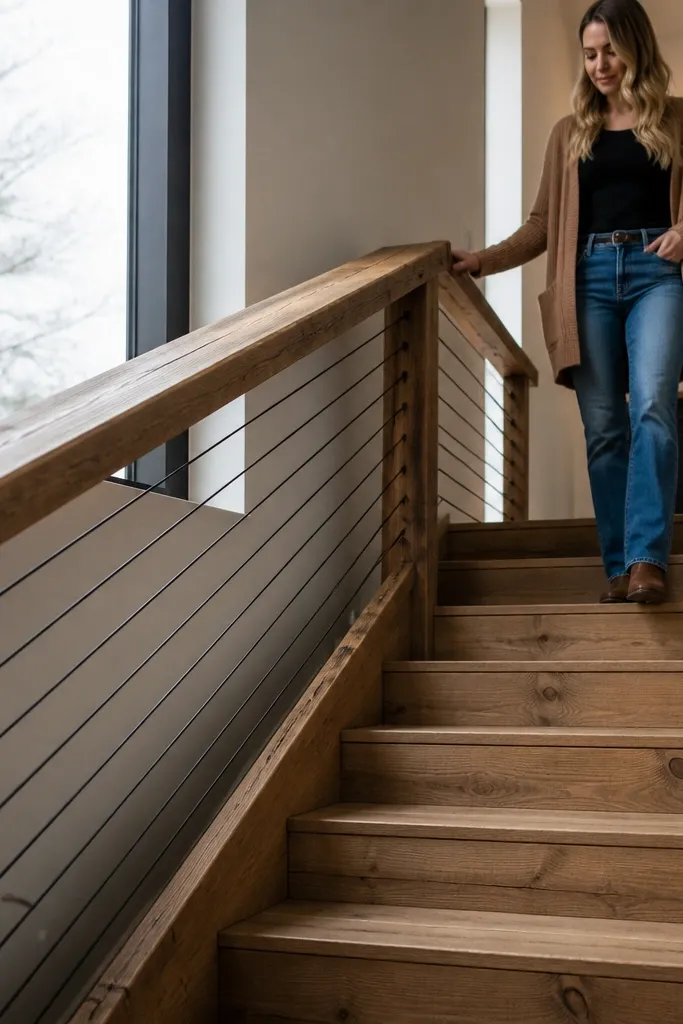
Cable infill gives you the clean, modern minimalist look — it disappears and lets light through. The warm part is the reclaimed pine top rail, which brings knots and subtle variation without looking rustic-chaotic. Add just one kick panel of wood so the railing still feels substantial at the bottom. This works great for wide stairs where you want openness but still want warmth near the floor.
Mount black steel cable posts along the stair line, keeping post spacing consistent so cable runs are straight. Cut and sand reclaimed pine to a straight top rail, then seal it with a matte finish (not glossy polyurethane). Install the cable kit by drilling holes at equal height on each post, threading cables, and tensioning with the included turnbuckles. Close the bottom with a single wood kick panel panel — measure the run length, cut to fit, and fasten from behind or with countersunk screws.
Before final tensioning, run all cables dry and check alignment from the landing — straighten now, not after tightening.
Don’t skip a matte sealer on the pine — shiny grain reads cheap fast.
3. Light oak handrail with vertical cedar boards and hidden fasteners
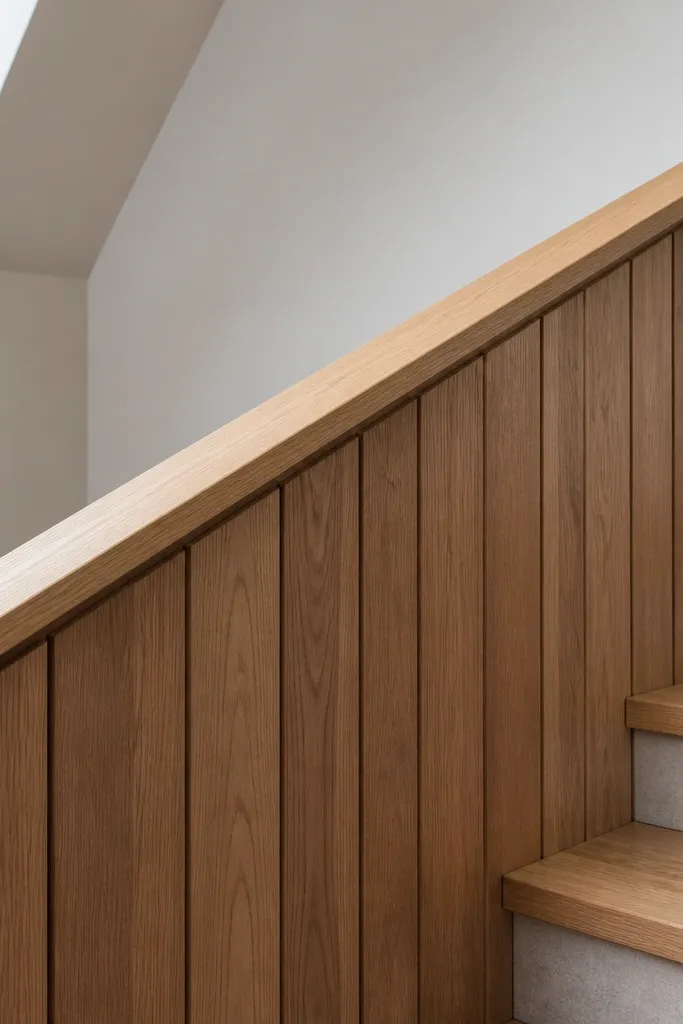
If you want warm and modern without metal, this is the cleanest route. Light oak keeps the color airy, while cedar boards add texture and a soft, rustic tone. Hidden fasteners keep the lines uninterrupted, which is the real minimalist move. This is a good choice for homes with lots of natural wood trim and for staircases where the railing is viewed straight-on.
Rip cedar boards to a consistent width and sand them smooth so they don’t snag hands. Build a simple top rail support frame under the oak handrail so you can attach boards from the underside. Install oak handrail first, level it along the stair angle, then attach cedar boards using hidden pocket screws from the underside of the handrail and from the back of a bottom rail. Finish by filling any micro-gaps with a matching wood filler and apply a matte clear coat.
Use a backer board when drilling pocket holes so each board starts square and you don’t get a twist down the run.
Don’t leave cedar rough — splinters ruin the look and the feel.
4. Oil-rubbed bronze horizontal bar with warm wood slat panel center
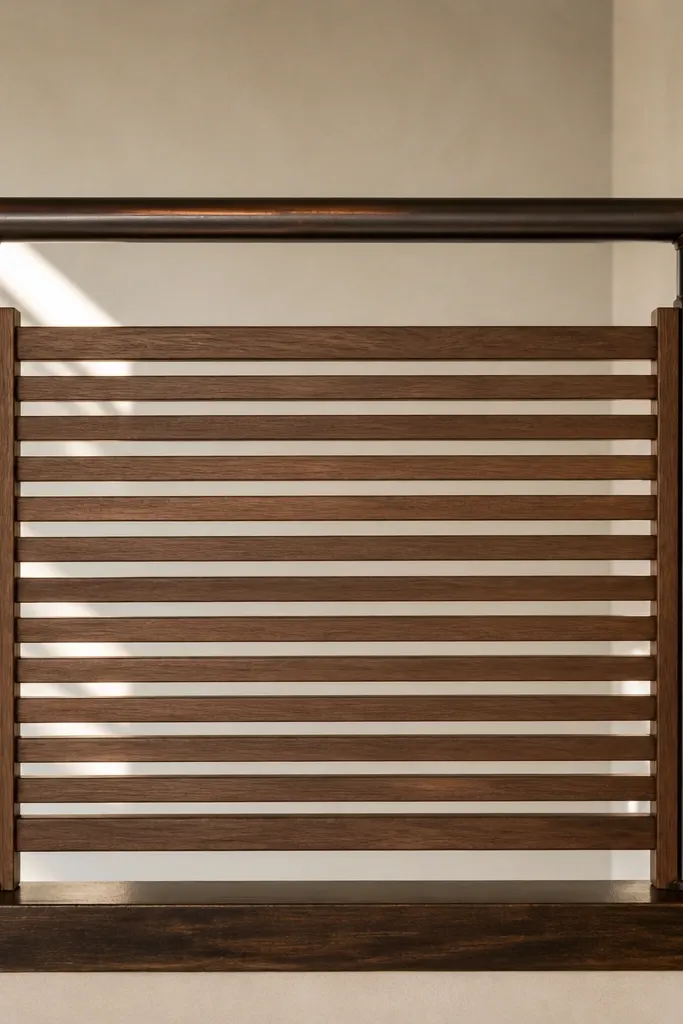
This design gives you modern lines through the horizontal bronze bar while keeping warmth through the wood slat panel. The key is balance: one strong metal element plus a wood section that feels handmade. The slats should be narrow and evenly spaced so the center panel reads clean, not decorative. Use it when you want the railing to look architectural, especially if your walls are neutral or painted.
Install oil-rubbed bronze posts or brackets first, then mount a single continuous horizontal bar at the correct height. Build the wood slat panel as a separate unit — frame it with a thin top and bottom rail, then attach slats with equal spacers. Fasten the finished panel between posts using screws from the back so the front stays flat. Sand edges lightly, then stain slats to match your floors and seal with a matte topcoat.
Make the slat spacing with a printed template taped to your workbench — it keeps every gap identical.
Don’t use thick, uneven slats — they read “craft project” instead of modern.
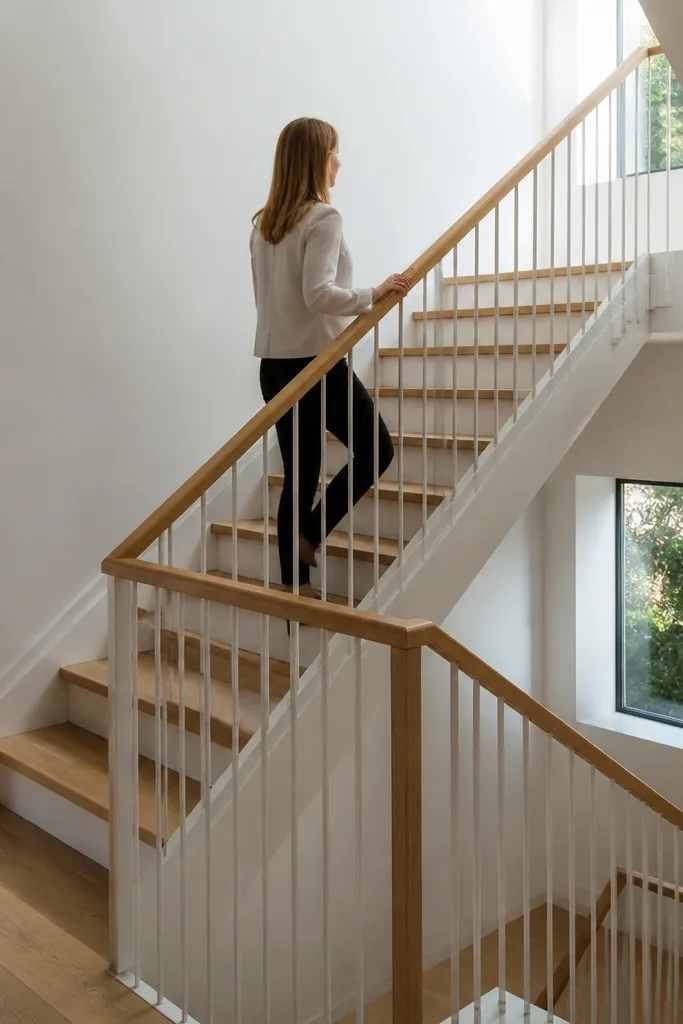
5. Walnut handrail with black steel vertical rods at wide spacing
Pick rod diameter around 3/8 in. To keep them visually thin. Mark rod locations along the stair line with a consistent spacing plan, then drill and mount rod sockets to the posts or stair stringer. Install the walnut handrail with a slight overhang for a finished edge — use brackets underneath so fasteners stay hidden. After rods are installed, check the railing from the landing for straightness and adjust any sockets before locking them down.
Wide spacing is the whole trick here. Vertical rods are minimalist because they’re thin, but wide gaps prevent the railing from looking busy. Walnut warms everything up, and the rods in matte black keep the line crisp. This is best for staircases where you want safety without blocking light, and for people who don’t want a full glass or cable system.
Skip thisDon’t go too tight on spacing — narrow gaps make the railing look heavy even with thin rods.
Editor's noteDry-fit one rod and measure the gap visually from eye level — spacing that looks perfect on the tape often needs a small tweak up top.
6. Whitewashed oak handrail with black lattice infill panel
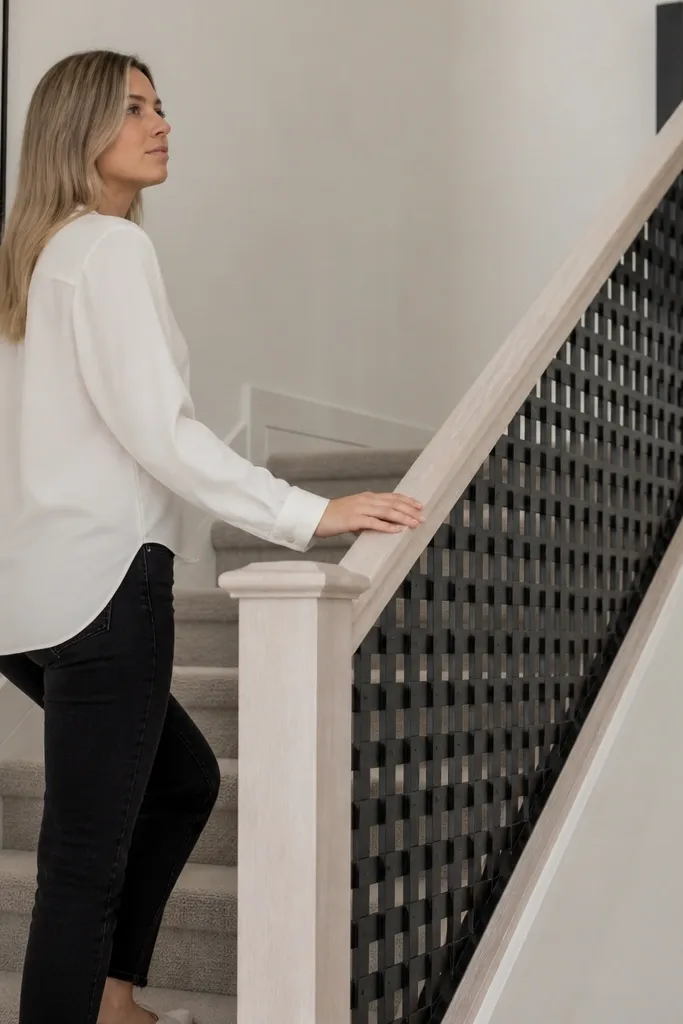
This one looks rustic but stays modern because the lattice is controlled and flat. Whitewashed oak keeps the wood from going too dark, and black lattice lines add graphic contrast without turning into clutter. Use this when your home’s palette is light and you want the railing to read as a design element, not just a safety feature. It also photographs well because the grid pattern catches light.
Frame a rectangular infill panel using thin rails that match your handrail height. Cut or buy a lattice panel sized to fit the frame, then sand edges so nothing is sharp. Mount the infill panel between posts with flush brackets so it sits tight to the frame. Install the whitewashed oak handrail on top, then seal with a matte finish to keep the white tone clean.
Use a level laser line for the handrail height — small shifts show up hard with lattice.
Don’t use a high-gloss lattice finish — it turns the pattern into glare.
7. Charred wood handrail with matte black vertical slat screen
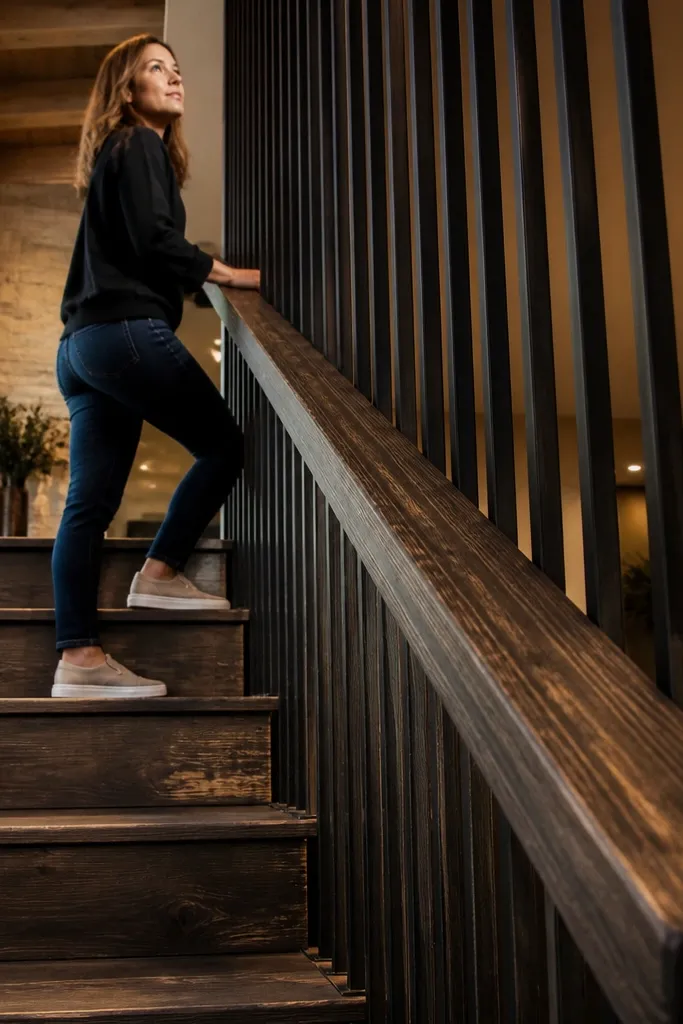
Start with your wood handrail pieces, char them evenly, then scrape and sand lightly to remove loose ash. Seal with a matte hardwax or matte oil so the finish doesn’t look chalky. Install matte black vertical slats in a frame under the handrail, using spacers to keep the gaps identical. Attach the slat frame to posts with hidden brackets and check that the handrail line stays smooth along the stair angle.
Charred wood (burnt finish) is the fastest way to make minimalist railing look rustic without adding extra parts. The depth of the black-brown handrail makes matte black slats feel intentional instead of redundant. Keep the slat screen simple — straight verticals with consistent spacing — and you get a warm, smoked look that still feels clean. This is a great choice for modern farmhouse interiors with black fixtures.
Skip thisDon’t leave charred wood unsealed — it rubs off and stains hands and sleeves.
Editor's noteWipe the charred surface with mineral spirits before sealing — it helps the finish look even.
8. Thick reclaimed beam handrail with simple two-post wood balusters
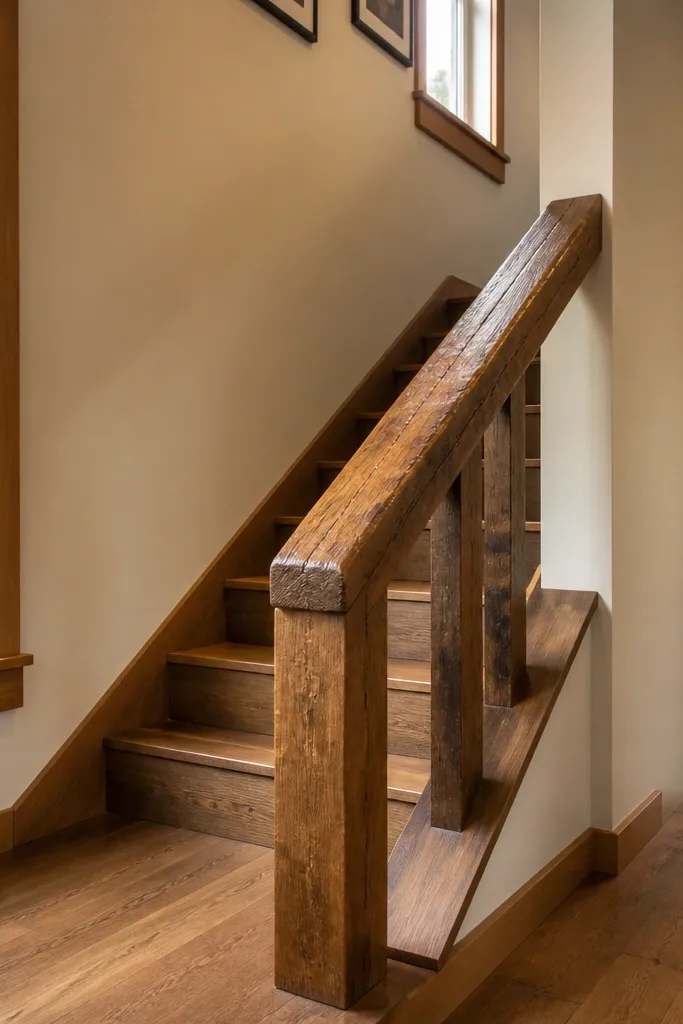
Choose a reclaimed beam sized so the handrail thickness lands around 2-3 in. After sanding to remove sharp edges, cut it to run length and pre-drill for bracket mounting. Install two wood balusters per opening, centered between posts, using mortise-style blocks or strong hidden brackets. Attach balusters first, then mount the beam handrail on top so it covers fastener points. Finish with a matte oil and a quick wipe-down to even the sheen.
This is a “less pieces, more material” railing. A thick reclaimed beam top rail reads warm because you can see the grain and edges. The balusters are kept minimal — just two substantial wood elements — so the railing stays modern minimalist instead of turning into a full spindle wall. It works well on narrower stairs where you want the railing to look bold rather than busy.
Skip thisDon’t sand the beam too smooth — the rough edges are part of the rustic warmth.
Editor's noteUse a template block to mark baluster centerlines so both sides match perfectly along the stair.
9. Rustic white oak handrail with smoked glass panels and thin black frames

Smoked glass gives you the clean modern look while the oak keeps it warm and grounded. The thin black frames keep lines minimal, so the railing doesn’t feel heavy. This option is photogenic because glass reflects light, and the smoke tint makes the railing feel soft instead of harsh. Use this for high-traffic stairs where you want openness but fewer visible wood parts.
Install thin black metal frames or brackets along the stair line at consistent intervals. Cut or order smoked glass panels sized to fit each opening, leaving a small clearance for gasket material. Mount glass using rubber gaskets and frame stops so edges don’t rattle. Then install the rustic white oak handrail on top and seal it with a matte clear coat to keep the grain warm.
Plan for gaskets before you lock in frame screws — they affect how snug the glass sits.
Don’t skip edge protection and gaskets — glass in metal without them sounds loose and chips.
10. Walnut handrail with vertical cable + wood spacer blocks for warmth
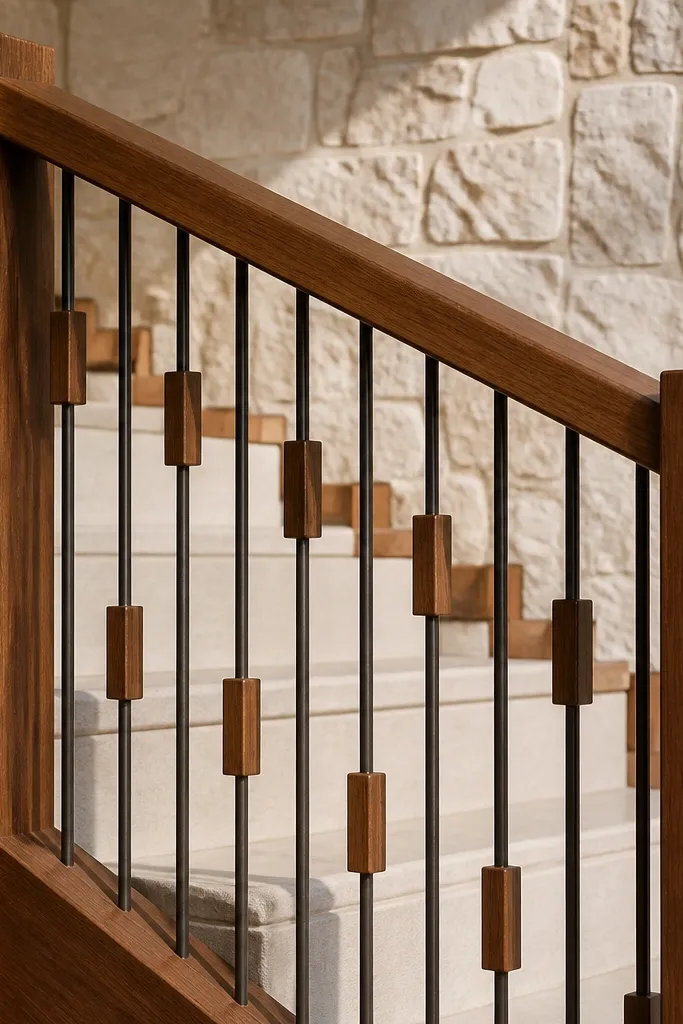
Mount posts with cable attachment points and drill holes aligned at the same height across the run. Install cables first so you can measure the exact cable-to-cable spacing. Cut walnut spacer blocks with a notch or drilled holes that fit around the cables, then slide them into place at equal intervals. Finish by sealing the walnut handrail and the spacer blocks with a matte finish so the wood doesn’t look shiny next to black cables.
This keeps the minimalist cable look but adds warmth where cables usually feel too cold. The wood spacer blocks break up the black lines and make the railing feel built, not factory. Keep blocks consistent in size and spacing so the design stays clean. This is a good fit when you want open sightlines but still want a rustic “material story.”
Skip thisDon’t mix wood colors between rail and blocks — it reads patchy fast.
Editor's noteMark cable spacing with a temporary painter’s tape grid before cutting blocks — it prevents off-by-a-few-millimeters mistakes.
11. Matte black steel frame with warm wood slat panels in sections
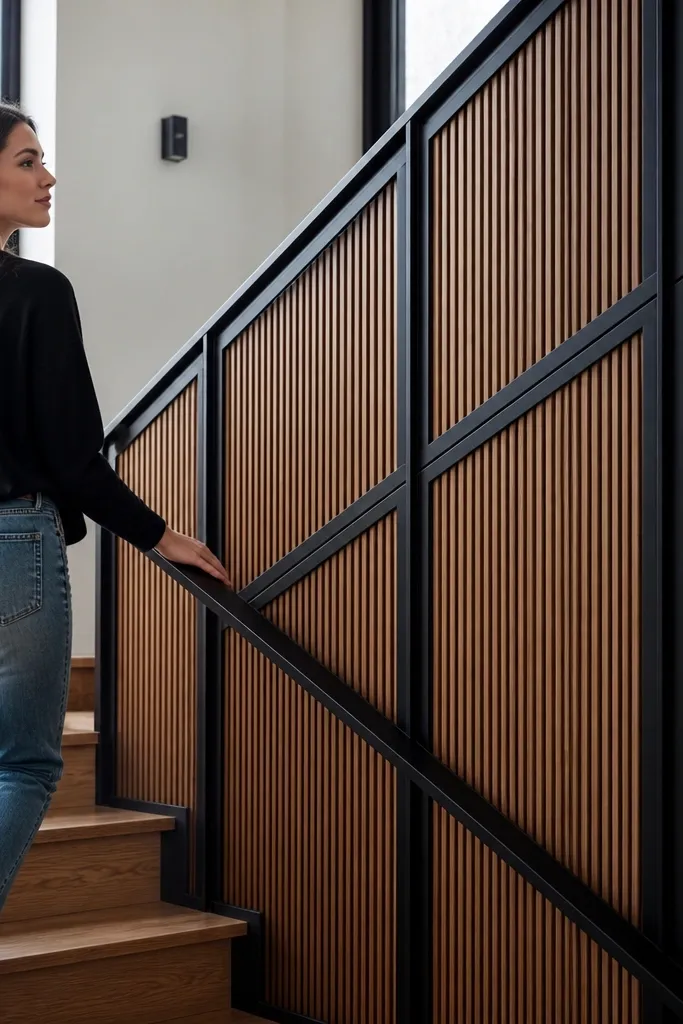
Segmented slat panels make a stair railing feel designed instead of assembled from random pieces. Matte black steel frames hold everything in a clean grid, and the wood slats bring the rustic warmth. The sectional approach also helps if your stairs have uneven runs — you can measure and build panels per bay. This is great for modern minimalist stair railing ideas when you want more privacy without going full solid wall.
Build or assemble steel frames for each bay between posts, keeping the frame width consistent. Cut wood slats to fit inside each frame, leaving a tiny uniform gap between slats so wood can expand and so light passes through. Attach slats with hidden fasteners from the back or with slat clips if you want easy future replacement. Install frames to posts, then mount the handrail on top and finish the slats with a matte stain and clear coat.
Label each bay number on your cut list — it saves time when stairs are not perfectly consistent.
Don’t lock slats too tight — wood needs a little breathing room to avoid warping.
12. Reclaimed timber handrail with minimalist iron scroll-free balusters
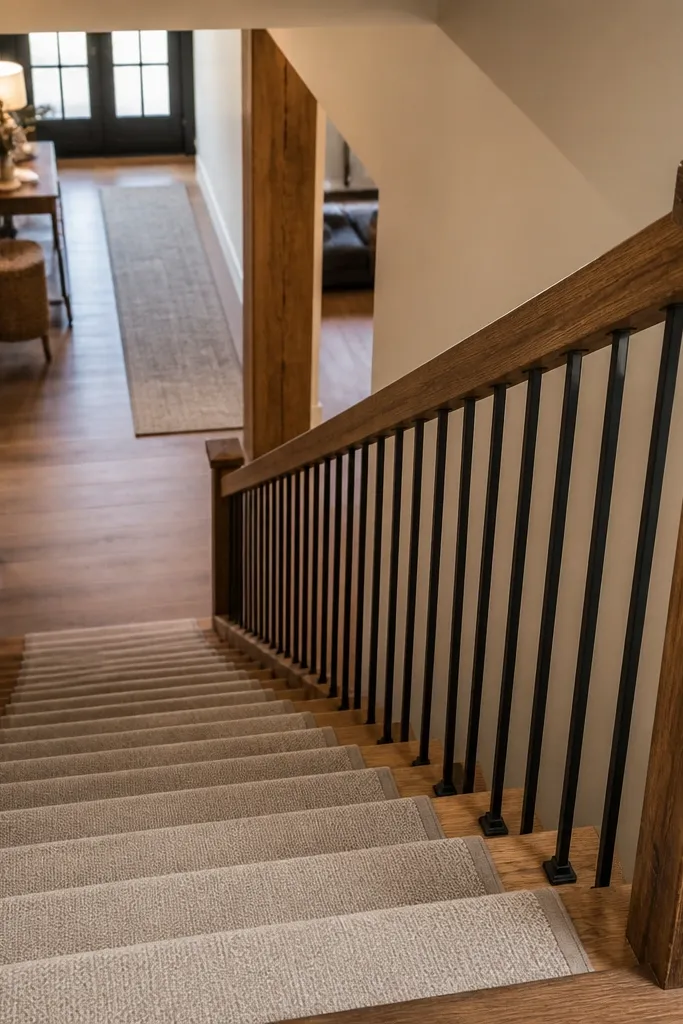
Rustic doesn’t require ornament. A reclaimed timber handrail brings the warmth and character, and scroll-free iron balusters keep the look modern minimalist. The trick is choosing straight or gently tapered balusters and keeping the tops and bottoms aligned. This works well when you want a classic railing vibe but your interior is more modern than traditional.
Choose iron balusters with straight profiles and consistent diameter. Install iron brackets and baluster mounts to the stair stringer or posts at measured intervals. Mount the reclaimed timber handrail on top using brackets that hide fasteners from the front. Sand the reclaimed wood, then stain to unify color, and apply a matte sealer. Finish by checking the balusters are level across the stair angle before fully tightening all mounts.
Use a string line along the top of balusters to spot any that are off before final tightening.
Don’t mix baluster styles — different profiles kill the minimalist look.
13. Two-tone railing with light oak handrail and dark stained vertical boards
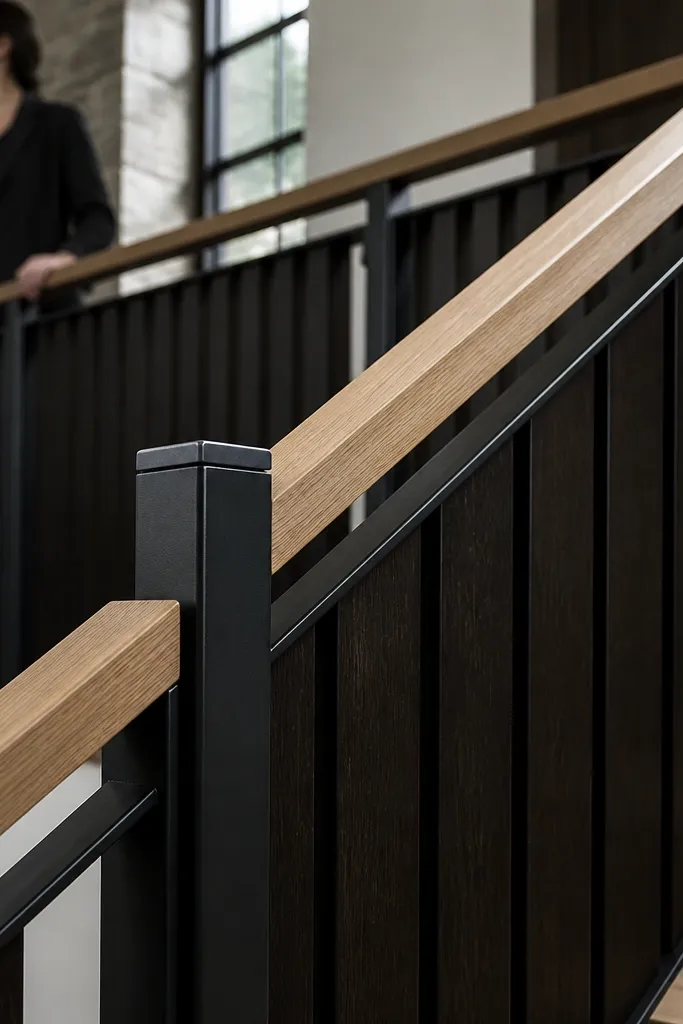
Stain vertical boards dark first, then seal them matte so the color stays even. Install matte black posts, then mount a light oak handrail on top with a soft edge profile. Attach the dark boards between posts using a hidden track or cleats to keep the front flat. Keep board widths consistent and use spacers for uniform gaps. Final step is a matte clear coat on the handrail so it doesn’t look yellow next to the dark stain.
Two-tone wood makes the railing feel warmer and more layered without adding extra parts. Light oak on the handrail reads airy, while dark stained vertical boards add depth and contrast. Matte black posts tie the colors together and keep the whole thing from looking like a DIY craft table. This design is especially good for stairs that sit against a light wall where contrast is needed.
Skip thisDon’t use semi-gloss on either tone — it looks patchy under stair lighting.
Editor's noteTest stains on offcuts next to your trim color — oak undertones shift the final look a lot.
14. Black cable railing with a vertical wood slat "anchor" at each post
Cables alone can look too industrial. This idea adds one vertical wood slat anchored at every post, so the eye catches warmth at regular intervals. It still reads modern minimalist because the cables remain the main infill and the wood anchors are consistent and minimal. Use this when you want openness but want the railing to feel more like your house and less like a loft.
Install posts for your cable system and drill cable holes at the same height on every post. Run and tension cables so they form straight lines. Cut wood slats sized to sit flush to the post face, then mount them to each post with hidden screws or brackets so fasteners don’t show. Seal slats in a matte finish that matches your handrail. Finish by rechecking cable tension after the wood is installed because adding slats can slightly shift alignment if mounts aren’t tight.
Make the slat width the same as the post face width so the reveal stays crisp.
Don’t add wood anchors in random locations — symmetry is what keeps it modern.
15. Stained cedar handrail with open channel steel baluster frame
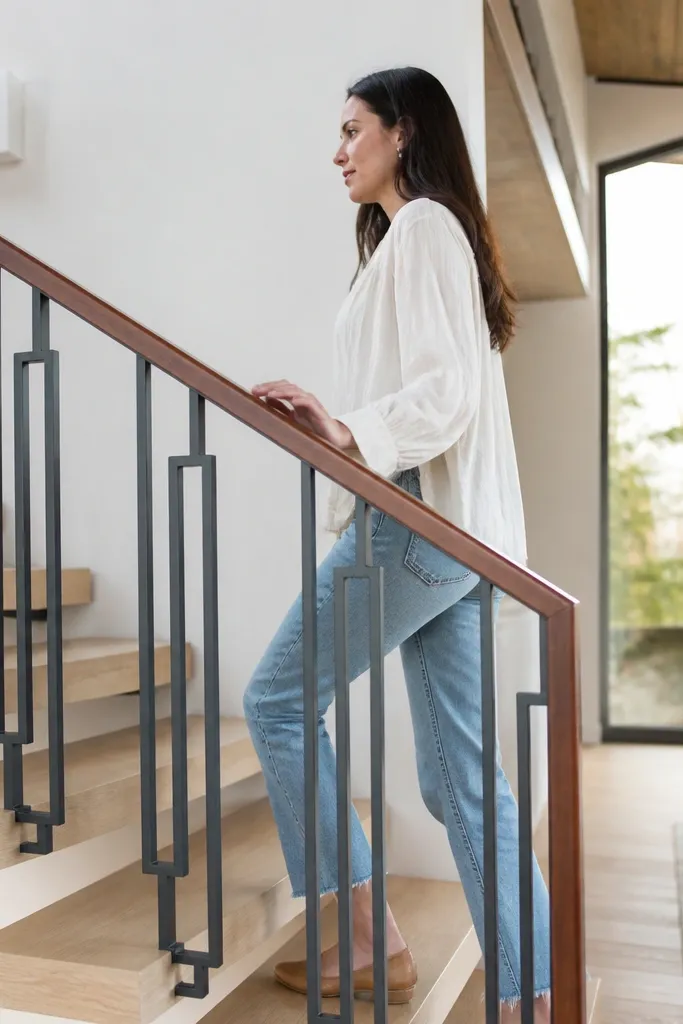
Open channel steel keeps the structure visible but light, which is perfect for modern minimalist stair railing ideas. Cedar handrail adds warmth and smell — the wood grain shows even under a matte finish. The channel frame makes the railing look engineered instead of decorated. This works for contemporary homes where you want metal present, but you don’t want the railing to feel cold or heavy.
Cut cedar for the handrail, sand smooth, and stain to a medium brown with a matte clear coat. Install open channel steel frames to the stair line using brackets that allow you to fine-tune height and plumb. Insert vertical baluster members or spacers inside the channel frame so the front stays clean. Bolt everything tight, then mount the handrail on top with concealed brackets under the rail. Check for any twist by sighting down the railing from the landing and adjusting brackets before final tightening.
Use shims behind brackets — they save you from re-drilling when the stair stringer isn’t perfectly straight.
Don’t paint cedar glossy — it clashes with the steel’s matte look.
16. Horizontal wood slat railing with thin black metal edge caps
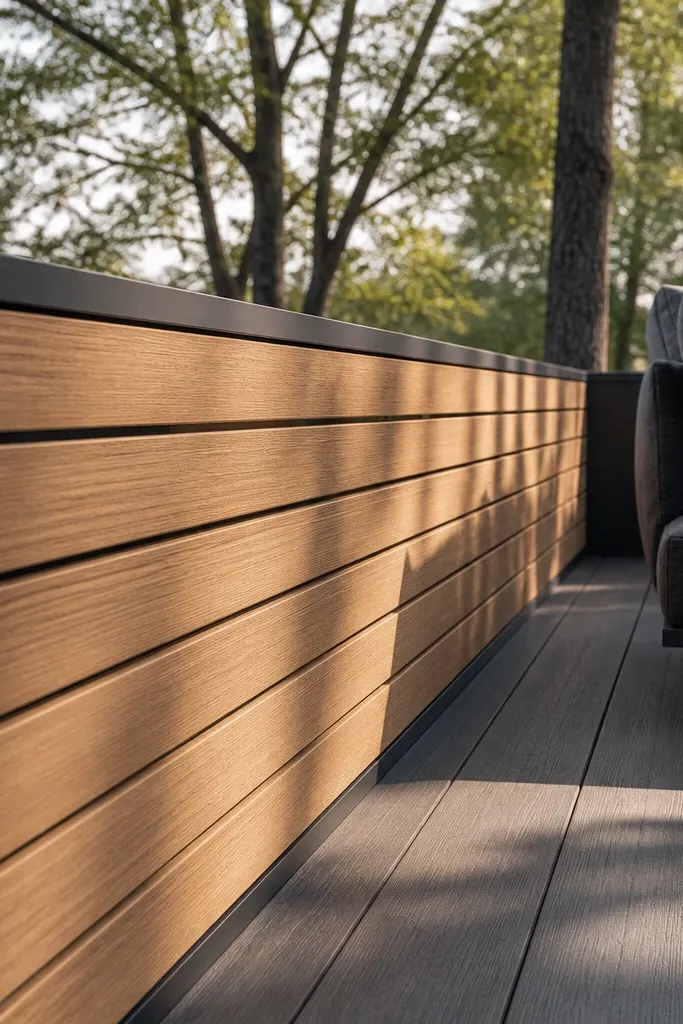
Horizontal slats read modern because the lines are calm and continuous. Add thin black metal edge caps and the whole thing looks intentional instead of like a fence panel. Wood slats bring warmth, especially if you choose oak or walnut and seal matte. This is best when you want the railing to look more like a built-in architectural feature than a set of individual spindles.
Build a backer frame for the slats and cut slats to uniform thickness. Attach slats to the frame using hidden screws so the front stays flat. Install thin black metal edge caps at the ends of the frame to create crisp boundaries. Mount the framed infill to posts, then add the handrail on top with a soft edge profile. Sand all exposed edges, then apply stain and matte sealer so the slats don’t look blotchy.
Clamp a straight guide while installing slats — it keeps the slat line consistent across the stair angle.
Don’t use wide slats — they make the railing bulky and visually loud.
17. Natural oak handrail with stacked leather-style strap balusters
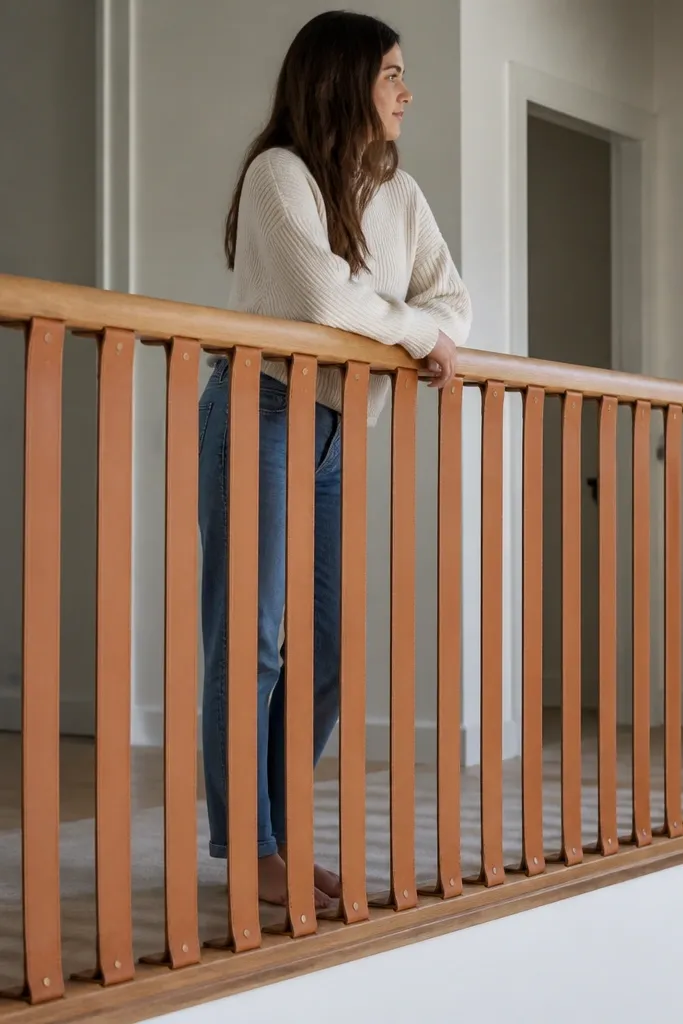
This one is minimalist because it uses repeatable, flat strips instead of round spindles. The warmth comes from natural oak and a matte, leather-like strap finish that looks soft rather than shiny. The straps read rustic-modern and feel architectural when the spacing is even. It suits modern minimalist stair railing ideas for people who want a softer visual texture without going full wood panel.
Install black metal posts with strap attachment points at consistent spacing. Cut strap material to length, then drill or punch holes to match the hardware spacing. Attach straps in a stacked pattern so each opening has the same number of straps and the same gap. Mount the oak handrail on top using concealed brackets. Finish by sealing the oak with matte clear coat and check that straps hang straight — adjust tension by tightening mounts evenly.
Dry-lay the strap lengths on the stair before drilling — it prevents strap twist and uneven hang.
Don’t use shiny strap finishes — they reflect stair lights and look cheap.
18. Hickory handrail with rope-twist balusters and blackened steel brackets
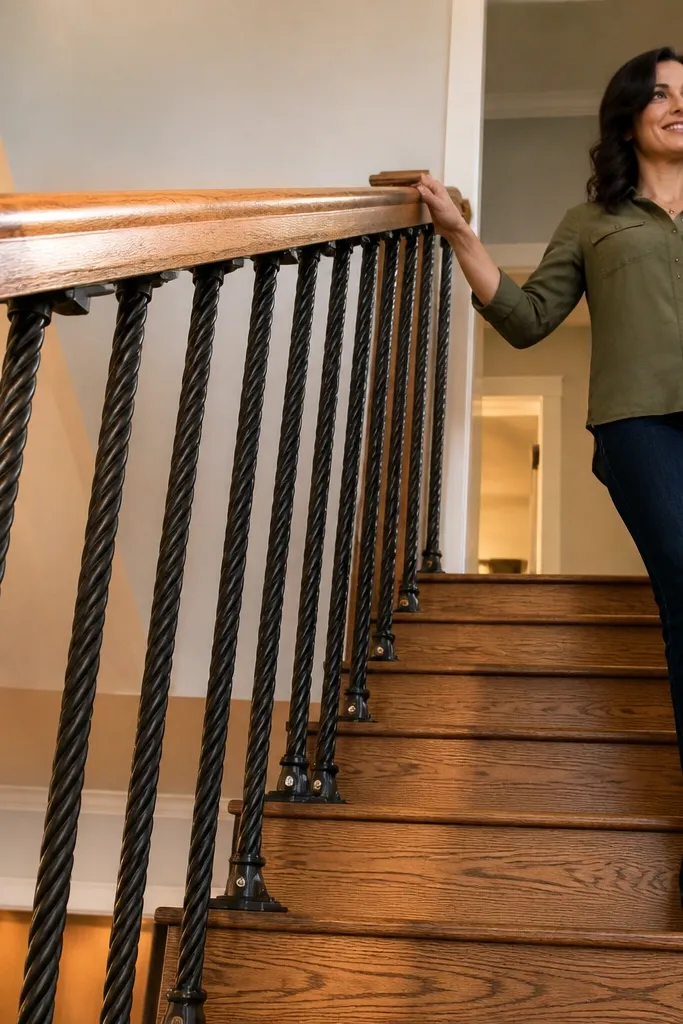
Cut a hickory handrail to match your stair run and keep it 1-1/4 in thick with a 1-1/2 in rounded top. Install blackened steel angle brackets at the ends and then mark evenly spaced baluster positions down the rail line; aim for 3-1/2 to 4 in between balusters so it looks airy but still sturdy. Use 1/2 in rope-twist balusters (real twisted rope look, not flat cord) and secure them to the brackets with threaded eye inserts on the bottom and small clevis-style connectors at the top. Pre-drill all metal holes, then screw into blocking — don’t rely on drywall. Seal the hickory with a matte water-based clear, then add a second coat after sanding with 180 grit.
This one feels warm because the balusters are soft and rope-like, not boxy. The hickory handrail has a honey-brown tone and visible grain, and the blackened steel brackets keep it modern minimalist stair railing instead of rustic-only. Use thick rope-twist balusters to add texture you can actually see from the landing. It suits entry stairs, farmhouse-modern foyers, and any space where you want “cozy” without turning the whole house into a cabin. Build it if you can cut straight lines and you’re comfortable drilling repeat holes — it’s not hard, it just takes patience to match spacing.
Skip thisDon’t attach brackets straight into studs that aren’t aligned with blocking — the rail will feel loose and the spacing will drift.
Editor's notePre-cut a simple spacing jig from scrap plywood so every baluster lands at the same height and the rope twist lines up.
19. Smoked cedar slat screen with live-edge walnut handrail and hidden standoff mounts
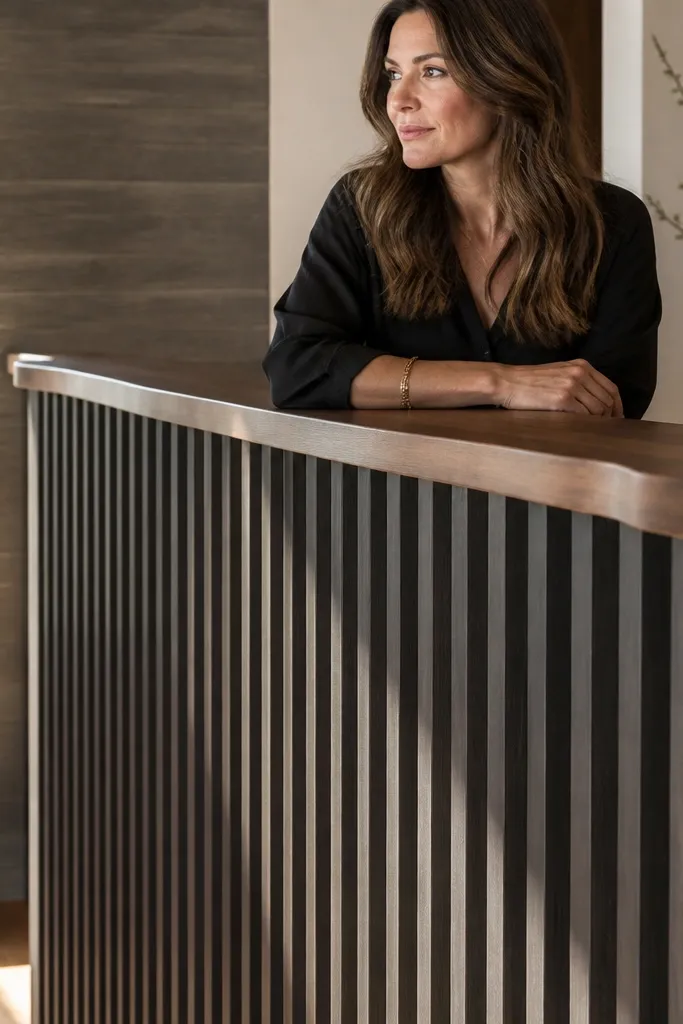
Choose a walnut live-edge board and rip it so the handrail is about 2 in wide, then smooth the top edge with a roundover bit or sand to a comfortable radius. Standoff-mount a vertical cedar slat screen behind the rail using aluminum or steel standoffs set 1-1/2 in behind the handrail line so it doesn’t look stuck-on. Cut cedar slats to 3/4 in thickness and 5/8 in spacing between slats; for a warm look, keep slats 1/8 in shorter than the opening height so the screen breathes. Smoke-stain the cedar before assembly, then let it dry fully and seal with a matte clear so the tone stays even. After mounting, run a final handrail touch-up with 220 grit and apply a second clear coat for grip.
This reads warm because the cedar slats have that smoky, slightly gray-brown tone that makes the whole railing feel like it’s been in the house for years. The live-edge walnut handrail adds a natural edge and soft irregularity, but the hidden standoff mounts keep it clean and modern minimalist stair railing. The slat screen blocks visual clutter from the stairs below, so the landing looks calmer and more intentional. It’s a great fit for narrow staircases where you want privacy and warmth without heavy panels. Skill level is medium: you’re cutting slats and drilling consistent standoff locations, so plan on a careful measuring day.
Skip thisDon’t stain after installation if you can avoid it — uneven coverage around slat edges makes the screen look blotchy.
Editor's noteDry-fit the slats on a flat surface first, then measure one “perfect” gap to set your spacer — it saves hours of re-marking.
20. Rustic steel tube frame with warm plaster infill and walnut cap rail
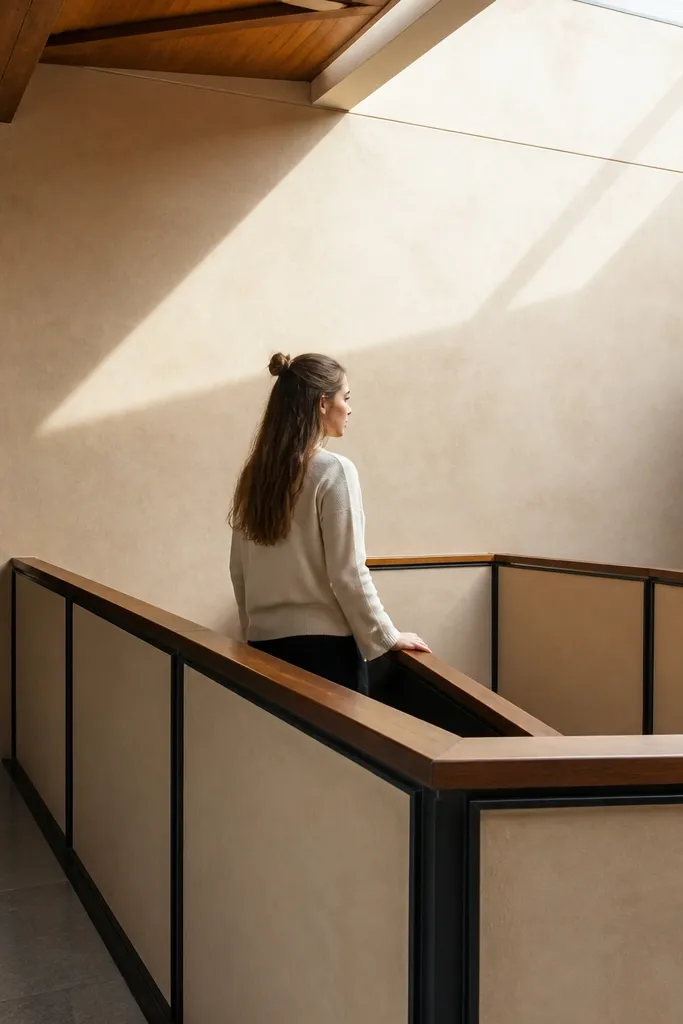
Frame two vertical steel tubes and horizontal rails to fit your opening, then add a top and bottom ledge so the plaster panel has something to bear on; use 1-1/2 in schedule 40 steel tube for a sturdy look. Cut a backing layer from 1/2 in cement board or fiber-cement sheet to the panel size, leaving a 1/4 in gap around the perimeter for movement. Screw the backing to the steel frame, then apply plaster in two coats: a scratch coat about 1/4 in thick, let it set, then finish coat to a smooth matte surface. Color the plaster with a warm earth pigment (sand or light clay) and seal with a matte masonry sealer once cured. Cap the top with a walnut rail and use countersunk screws from underneath so the wood looks clean.
This one feels warm because the infill is plaster — it has that soft, matte surface that reads cozy instead of cold. The steel tube frame keeps the structure crisp and modern minimalist stair railing, while the walnut cap rail ties it back to wood warmth. It also solves a common problem: stairs often look busy below the handrail, and a plaster panel calms the view without making the railing look heavy. This suits modern farmhouses, renovated townhomes, and interiors with light walls where you want texture. Build it if you’re comfortable with basic metal framing and you can mix and patch plaster cleanly.
Skip thisDon’t use drywall for the infill backing — it cracks and chips as the plaster cures and the frame shifts.
Editor's noteTape off the walnut cap edges before plastering so you don’t spend hours scraping dried plaster off the finish.